A Child with Anaphylaxis Presented as Spasmodic Croup - A Case Series
Roshan PK*
Department of Emergency Medicine, Government Medical College, Thiruvananthapuram, India
Published Date: 2025-07-23Roshan PK*
Department of Emergency Medicine, Government Medical College, Thiruvananthapuram, India
- *Corresponding Author:
- Roshan PK Department of Emergency Medicine, Government Medical College, Thiruvananthapuram, India E-mail:pkroshansahib@gmail.com
Received date: February 25, 2025, Manuscript No. IPPECM-24-20232; Editor assigned date: February 27, 2025, PreQC No. IPPECM-24-20232 (PQ); Reviewed date: March 13, 2025, QC No. IPPECM-24-20232; Revised date: July 16, 2025, Manuscript No. IPPECM-24-20232 (R); Published date: July 23, 2025, DOI: 10.36648/ipsrt.9.2.156
Citation: Roshan PK (2025) A Child with Anaphylaxis Presented as Spasmodic Croup-A Case Series. Pediatr Emerg Care Med Open Access Vol:9 No:2
Abstract
Acute stridor is a sign of acute life-threatening airway compromise. Congenital malformations, life-threatening obstructions, acute infections, or anaphylaxis can cause stridor. Acute causes of stridor encompass conditions such as croup, bacterial tracheitis, epiglottitis, retropharyngeal abscess, foreign body aspiration, peritonsillar abscess, airway burns, and anaphylaxis. Here, we present 2 cases who presented with acute onset of persistent brassy cough and stridor later diagnosed with anaphylaxis presenting as spasmodic croup.
Keywords
Spasmodic croup; Anaphylaxis; Atypical croup
Introduction
Acute stridor is a sign of acute life-threatening airway compromise. It can be caused by congenital malformations, lifethreatening obstructions, acute infections, or anaphylaxis. Acute causes of stridor include croup, bacterial tracheitis, epiglottitis, retropharyngeal abscess, foreign body aspiration, peritonsillar abscess, airway burns, and anaphylaxis. Croup is the primary cause of stridor in infants and children, often attributed to the parainfluenza virus. It is characterized by a distinctive barking cough, hoarseness, and stridor due to inflammation and narrowing of the larynx and trachea. The disease is typically selflimited, resolving within one week. Here we present 2 cases of atypical croup later diagnosed as anaphylaxis [1].
Anaphylaxis is a severe, life-threatening systemic hypersensitivity reaction characterized by rapid onset and the potential for fatal airway, breathing, and circulatory compromise. It is most commonly triggered by foods, medications, insect stings, or latex exposure in children [2]. The classic presentation includes cutaneous manifestations such as urticaria and angioedema, respiratory symptoms like wheeze and stridor, gastrointestinal complaints, and cardiovascular instability. However, not all cases follow the typical pattern. Atypical presentations can delay recognition and treatment, increasing the risk of morbidity and mortality. One such unusual presentation is the occurrence of symptoms resembling spasmodic croup [3].
Spasmodic croup, a variant of croup typically seen in young children, is characterized by sudden onset of barking cough, inspiratory stridor, and hoarseness, often occurring at night and without significant fever. It is generally considered viral or allergic in origin and tends to resolve with supportive care and standard therapies such as corticosteroids and nebulized epinephrine. Because of its relatively benign and self-limiting course, clinicians may not initially suspect a more serious underlying etiology when a child presents with stridor and a barking cough [4].
The overlap in clinical features between anaphylaxis and spasmodic croup particularly upper airway obstruction due to laryngeal edema can create diagnostic challenges. In some cases, anaphylaxis may primarily manifest with acute laryngeal edema, mimicking croup without prominent skin or cardiovascular findings [5]. Failure to promptly recognize anaphylaxis in such scenarios may delay the administration of intramuscular epinephrine, the first-line and potentially lifesaving treatment.
This case series highlights children who presented with clinical features suggestive of spasmodic croup but were ultimately diagnosed with anaphylaxis. By examining their presentation, diagnostic course, management, and outcomes, this report aims to raise awareness of this rare but critical presentation. Early recognition of atypical anaphylaxis is essential to ensure timely intervention and improve patient safety in pediatric emergency settings [6].
Case Presentation
Case 1
A 7-year-old child presented to the ER with a sudden onset of shortness of breath and noisy breathing around 3 A.M. after going to bed. On arrival at the ED, the patient was triaged red and shifted to the paediatric resuscitation bay.
The patient had no history of fever, cough, or rhinitis and was afebrile to touch. There was no history of asthma or allergic reactions in the past. An immediate bedside X-ray showed a steeple sign (Figure 1). The Westley Croup score was calculated to 8, suggestive of severe croup. In view of suspected croup, adrenaline nebulization and injection dexamethasone 0.6 mg IV were given. Despite the treatment, stridor and brassy cough persisted with respiratory distress. On detailed history, it was found that the patient had eaten squid in the afternoon, which she had not had before, and there was a family history of allergies to multiple drugs and seafood. A bedside airway ultrasound showed edematous vocal cords with turbulent airflow. In view of suspected anaphylaxis, 0.3 mg of 1/1000 adrenaline was given intramuscularly in the anterolateral thigh. After 5 minutes, respiratory distress reduced, O2 requirement decreased, and saturation improved to 98% in room air. Child CBC, CRP were within normal limits, ruling out infection. The child was admitted for close monitoring and discharged the next day.
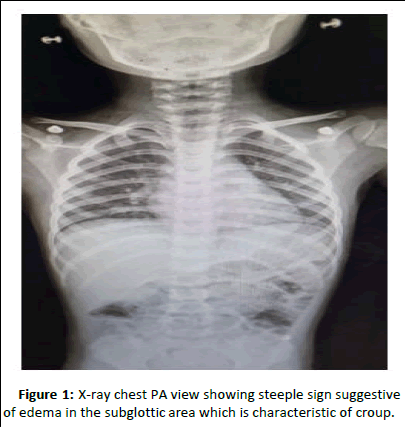
Figure 1: X-ray chest PA view showing steeple sign suggestive of edema in the subglottic area which is characteristic of croup.
Case 2
A 10-year-old boy presented to the ER with sudden onset of noisy breathing and brassy cough with multiple episodes of vomiting and woke up from sleep in the afternoon. On arrival at the ED, the patient was triaged red and shifted to the pediatric resuscitation bay.
Examination:
• Airway: Stridor and brassy cough.
• Breathing: RR 34 bpm, SaO2 84% in RA, AE bilateral wheeze.
• Circulation: BP 100/70 mmHg, PR 145 bpm, CRT<2 sec.
• Disability: E4V5M6, temperature 36°C.
On detailed history, the mother said he had oyster for the first time in the morning. There was no history of fever or cough. Along with the cough, he had multiple episodes of vomiting with abdominal pain. An X-ray chest and neck showed a steeple sign suggestive of subglottic edema. An X-ray chest showed a diffuse opacity suggestive of negative pressure pulmonary edema (Figure 2). He was given inj. adrenaline 0.3 ml IM and inj. hydrocortisone 100 mg IV. Adrenaline nebulizations were also started. Symptoms were not resolved; two more doses of adrenaline IM were given, and later adrenaline infusion was started. Patient symptoms started improving gradually. Repeat chest X-ray was normal. The patient was shifted to ICU and monitored and discharged on day 2.
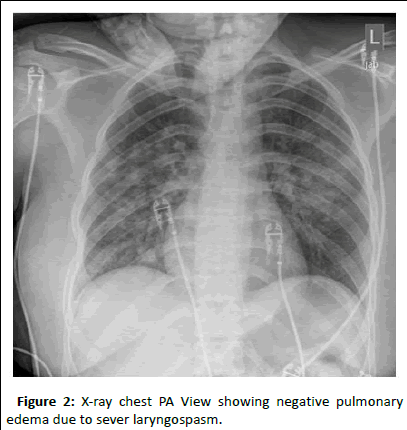
Figure 2: X-ray chest PA View showing negative pulmonary edema due to sever laryngospasm.
Results and Discussion
This case highlights the importance of considering anaphylaxis in the differential diagnosis of acute respiratory distress in children, especially when there is a history of exposure to potential allergens. The initial presentation mimicked spasmodic croup, but the persistence of symptoms despite standard treatment for croup and the detailed history pointed towards anaphylaxis. Prompt recognition and treatment with intramuscular adrenaline were crucial in managing the patient’s condition effectively.
Conclusion
Anaphylaxis can present with symptoms similar to croup, making diagnosis challenging. A thorough history and consideration of potential allergens are essential in such cases. Early administration of adrenaline can be lifesaving and should be considered when standard treatments for croup are ineffective.
References
- Pfleger A, Eber E (2016) Assessment and causes of stridor. Paediatr Respir Rev 18:64-72
[Crossref] [Google Scholar] [PubMed]
- Sasidaran K, Bansal A, Singhi S (2011) Acute upper airway obstruction. Indian J Pediatr 78:1256-1261
[Crossref] [Google Scholar] [PubMed]
- Marx A, Török TJ, Holman RC, Clarke MJ, Anderson LJ (1997) Pediatric hospitalizations for croup (laryngotracheobronchitis): biennial increases associated with human parainfluenza virus 1 epidemics. J Infect Dis 176:1423-1427
[Crossref] [Google Scholar] [PubMed]
- Grabenhenrich LB, Dölle S, Moneret-Vautrin A, Köhli A, Lange L, et al. (2016) Anaphylaxis in children and adolescents: The European Anaphylaxis Registry. J Allergy Clin Immunol 137:1128-1137
[Crossref] [Google Scholar] [PubMed]
- Khaleva E, Franz A, Garvey LH, Jay N, Ylescupidez A, et al. (2020) Perioperative anaphylaxis in children: Etiology, time sequence, and patterns of clinical reactivity. Pediatr Allergy Immunol 31:85-94
[Crossref] [Google Scholar] [PubMed]
- Cassedy EA, Kim S, Silver AH (2021) An unexpected cause of croup in a pediatric patient. Clin Pediatr 60:574-576
[Crossref] [Google Scholar] [PubMed]

Open Access Journals
- Aquaculture & Veterinary Science
- Chemistry & Chemical Sciences
- Clinical Sciences
- Engineering
- General Science
- Genetics & Molecular Biology
- Health Care & Nursing
- Immunology & Microbiology
- Materials Science
- Mathematics & Physics
- Medical Sciences
- Neurology & Psychiatry
- Oncology & Cancer Science
- Pharmaceutical Sciences